Desert Eagle Films Wraps 2025 With a Breakout Debut and Sets a Strong Course for 2026
- Desert Eagle Films

- Jan 2
- 6 min read

For Desert Eagle Films, 2025 did not arrive as a sudden breakthrough. It arrived as the natural consequence of years spent building quietly, deliberately, and with intent. What the world saw this year was not the start of a journey, but the moment a foundation became visible.
The completion of Kemet: Year One marked more than the studio’s first feature film. It marked the activation of a system that had been under construction for three years — a system designed to produce ambitious cinema from this region without compromise, shortcuts, or dependency on external authorship.
A Studio Built Before a Film
Desert Eagle Films was never conceived as a company chasing output. From the beginning, the focus was on structure: how stories are developed, how teams are assembled, how productions are executed under real conditions, and how a studio can sustain itself beyond a single title.

For three years leading into 2025, the work happened mostly out of sight. Original intellectual property was developed internally. Creative and technical leadership was assembled with long-term collaboration in mind. Production workflows were designed to function in remote locations, under environmental pressure, and within compressed schedules. Financial and operational systems were built to support scale, not just survival.
By the time cameras rolled on Kemet, the production was operating from a position of preparation, clarity, and control. Every department entered principal photography with defined standards, established workflows, and a shared understanding of the execution required. At the same time, the team was structured to adapt rapidly to changing conditions, recognizing that shooting entirely in natural environments demands flexibility, decisiveness, and respect for forces beyond the schedule.
Rather than resisting the landscape, the production worked with nature as a collaborator — adjusting blocking, camera movement, and logistics in real time to weather, terrain, light, and environment, without compromising creative or technical standards.
As Mo Ismail, Founder and Executive Producer of Desert Eagle Films, stated during production "The objective was never discovery on set. The groundwork had already been laid. The responsibility was to execute decisively, adapt intelligently, and use the natural world to strengthen the film rather than fight against it — delivering a production that was both controlled and alive"
The World Cinema Context of 2025

The timing of Kemet: Year One mattered.
Across global cinema in 2025, audiences showed a growing appetite for films rooted in place and identity — stories that did not flatten culture for universality, but trusted specificity to travel. Regional cinema gained renewed prominence, practical filmmaking regained cultural value, and large-scale productions increasingly leaned back toward physical craft after years of digital excess.
Within this landscape, Kemet did not attempt to follow a trend. It addressed something largely untouched: the earliest human history of Egypt, long before dynasties, pharaohs, or written language.
That absence was not accidental. It exists because this period is difficult to depict responsibly. There are no texts to adapt, no surviving architecture to recreate, no iconography to replicate. Everything must be reasoned, researched, and imagined with restraint.

Kemet was conceived to meet that responsibility head-on.
KEMET: Year One and the Weight of Time
Kemet: Year One is set approximately 12,000 years from now, in 9186 BC, at the threshold between survival and civilization. This is pre-dynastic Egypt in its truest sense — a world defined by land, water, movement, belief, and the earliest forms of social order.
The film does not depict monuments or empires. It explores conditions: how humans lived together, how leadership emerged, how conflict shaped community, and how the relationship between people and environment laid the groundwork for everything that followed.

There was no template for this world. Every choice — from dwellings and tools to movement, ritual, and social behavior — had to be constructed from first principles. With no written records, surviving architecture, or visual canon to reference, the production was required to reason its way into the past, drawing from anthropology, early human behavior, environmental logic, and practical necessity rather than imitation.
This demanded a level of restraint as much as imagination. Nothing could exist on screen unless it served a functional purpose within that world. Objects were designed to be used, not displayed. Spaces were shaped by survival, not aesthetics. Movement and ritual emerged from environment, need, and human interaction rather than symbolism imposed after the fact.
That responsibility informed every production decision that followed — from how villages were laid out and constructed, to how actors occupied space, to how the camera moved through environments that had to feel discovered rather than staged. The result was a world built not to be observed from a distance, but to be inhabited — one whose authenticity was earned through logic, discipline, and respect for the unknown rather than spectacle.
Building a World With Hands, Not Shortcuts

Early in development, Desert Eagle Films made a defining commitment: the world of Kemet would be physically built. Not approximated. Not simulated. Built.
In under three weeks, multiple full-scale prehistoric villages were constructed entirely by hand. Natural materials — stone, mud, wood, rope, earth — were shaped into functional environments that could be lived in, not just photographed. These were not decorative sets.
They were real spaces, engineered to withstand weather, performance, and continuous use.
Actors did not imagine the world around them. They moved through it. They leaned on it. They fought within it. The environment responded because it was real.


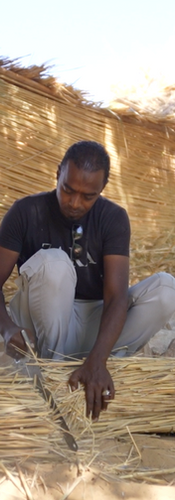


Following this intensive build phase, principal photography was completed in fewer than twenty-one shooting days. For a production of this physical scale — remote locations, large crews, extensive action, and complex logistics — the schedule was exceptionally compressed. The only way it held was through preparation, discipline, and unified leadership across every department.
During production, Kemet: Year One also achieved one of the longest continuous one-take sequences ever executed in Egyptian & Middle Eastern cinema, requiring precise coordination between performance, camera choreography, and environmental continuity.
The entire film was co-financed and executed end-to-end locally by Desert Eagle Films and BUC Studios, with both partners retaining full creative and operational control throughout the process. The collaboration combined Desert Eagle Films’ production leadership with BUC Studios’ academic depth, research capacity, and on-ground infrastructure, forming a partnership that proved instrumental to the scale, precision, and execution of Kemet: Year One.
A Film That Proved a Studio
Kemet: Year One was conceived not as a standalone achievement, but as a deliberate proving ground. From the outset, the film was structured to test the full range of Desert Eagle Films’ capabilities — not in theory, but under real production conditions.
Across 2025, the project placed sustained operational demands on the studio: leading large crews across remote and logistically complex terrain, maintaining international technical standards under constant pressure, executing on compressed schedules, and protecting creative intent without compromise. Every phase of the production required coordination, decisiveness, and accountability at scale.
By the completion of principal photography, the outcome was unequivocal. Desert Eagle Films had moved decisively beyond development mode. The studio emerged as a fully operational production entity, with systems, leadership, and workflows validated in real-world conditions and ready to support a continuing slate of ambitious work.

Beyond the Film: What 2025 Actually Built
Kemet: Year One stands at the center of 2025, but its impact reached far beyond the frame.
By executing the film entirely on the ground, Desert Eagle Films demonstrated that large-scale cinema can be built regionally without outsourcing authorship, erasing cultural ownership, or compromising professional standards. The production activated real creative economies—local crafts, crews, and technical departments working at scale—proving that ambitious filmmaking can be rooted in place and still meet international expectations.
This was not a symbolic exercise. The work carried real responsibility, real pressure, and real consequence. Emerging talent was not placed on the sidelines or sheltered behind theory. They were integrated into professional workflows, held to clear standards, and trusted with real accountability. The result was not just participation, but growth—earned through execution rather than proximity.
What 2025 ultimately delivered was structural credibility. The year proved that Desert Eagle Films could operate responsibly, sustainably, and at scale—not once, but as a repeatable model.
Momentum, Not Distraction
With Kemet: Year One completed and advancing into its next phase, Desert Eagle Films enters 2026 with clarity rather than noise.
The studio has confirmed that Lost in Sinai will move into pre-production in Spring 2026, marking the next step in a carefully sequenced slate. In addition, two further feature projects have completed development, forming part of a broader multi-year roadmap already in motion. These projects are not departures from what was established with Kemet; they are continuations—built on the same principles of preparation, discipline, and control.
Details will be shared deliberately and in time. The emphasis remains on substance over announcement.
The focus moving forward is unchanged: build carefully, execute decisively, and expand without diluting standards.
Closing the Year, Setting the Ground
2025 will be remembered as the year Desert Eagle Films moved from preparation to presence.
Kemet: Year One stands as the studio’s first definitive statement—a film built by hand, grounded in history, and executed under real conditions with discipline and intent. It reflects not only what was achieved, but how it was achieved.
This is not an endpoint. It is the foundation.
Everything that follows will be built on what was proven here.
What follows will be built on what was proven here.
PUBLISHER INFORMATION
Publisher: Desert Eagle Films — Editorial & Studio Records Division
Title: Desert Eagle Films Wraps 2025 With a Breakout Debut and Sets a Strong Course for 2026
Date: December 31, 2025


Comments